

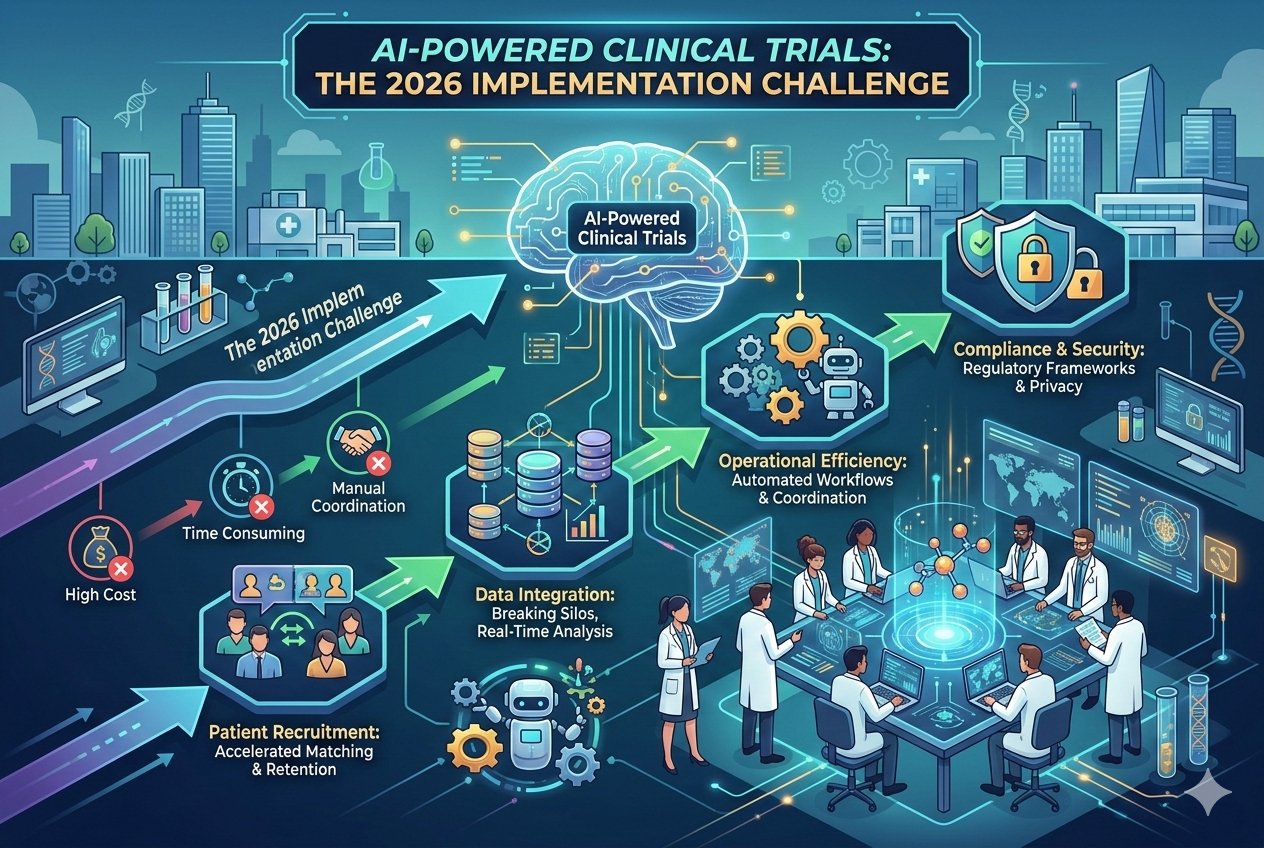
Clinical trials have always been expensive, time-consuming, and heavily dependent on manual coordination. Patient recruitment delays, data silos, compliance complexities, and operational inefficiencies continue to slow innovation across pharma, biotech, and CRO ecosystems.
But 2026 is shaping up to be different.
Ai is no longer an experimental layer sitting on top of clinical systems. It is becoming the core engine reshaping how trials are designed, executed, monitored, and optimized.
Recent industry data shows:
⮞ AI-powered patient recruitment tools can improve enrollment rates by up to 65%
⮞ Predictive analytics models are reaching nearly 85% accuracy in forecasting trial risks and outcomes
⮞ Organizations integrating AI into clinical workflows are accelerating timelines by 30–50%
⮞ Operational costs are decreasing by as much as 40%
However, these outcomes only happen when AI is fully embedded into production-grade systems — not when it remains a pilot project or strategic discussion.
The real challenge in 2026 is not AI capability — it is AI implementation.
AI-Powered Patient Recruitment: Beyond the Algorithm
One of the most impactful applications of AI in clinical research is patient recruitment. Machine learning and natural language processing can:
⮞ Interpret complex inclusion and exclusion criteria
⮞ Extract insights from unstructured clinical notes
⮞ Identify eligible patients across multiple hospitals
⮞ Predict enrollment probability and drop-out risks
On paper, the technology works. In reality, scaling it requires deep technical integration.
To operationalize AI-driven recruitment, organizations must build:
⮞ Secure integrations with hospital EHR systems
⮞Compliant data extraction and transformation pipelines
⮞Role-based access control frameworks
⮞ Coordinator-friendly dashboards
⮞ Workflow automation embedded within existing clinical operations
Without infrastructure, AI insights remain unused.
At Yuva Infocare, we design and deploy end-to-end AI-enabled patient recruitment systems that integrate seamlessly into healthcare IT ecosystems. Our focus is not just model accuracy, but usability, compliance, and scalability.
Decentralized Clinical Trials: Infrastructure Is Everything:
The rise of decentralized clinical trials (DCTs) is accelerating. Sponsors increasingly demand remote monitoring, wearable integration, telehealth connectivity, and real-time patient data capture.
But decentralization introduces system-level complexity.
Successful decentralized trial platforms require:
⮞ Multi-site secure cloud architecture.
⮞IoT and wearable device data ingestion pipelines.
⮞End-to-end encrypted patient data transmission.
⮞Real-time monitoring and analytics dashboards.
⮞Regulatory-compliant audit trails and documentation.
This is not standard software development. It is healthcare-grade systems engineering.
We develop secure, cloud-based clinical trial platforms that support decentralized trial models while ensuring regulatory readiness and operational resilience.
Real-World Evidence & Data Integration Challenges:
AI thrives on data — but healthcare data is fragmented.
EHR systems, claims databases, lab systems, imaging platforms, and patient-reported outcomes operate in silos. Unlocking real-world evidence (RWE) requires connecting these systems into a unified, compliant architecture.
That involves:
⮞HL7 and FHIR interoperability standards.
⮞Data normalization and validation frameworks.
⮞Secure API development.
⮞Advanced analytics infrastructure.
⮞Privacy-first and HIPAA-compliant design.
Organizations looking to leverage real-world data must approach it as a full-scale engineering initiative, not just a data science experiment.
Adaptive Clinical Trial Systems in 2026:
AI enables one of the most transformative concepts in clinical research: adaptive trials. Adaptive trials modify protocols based on interim data insights — optimizing dosage arms, enrollment criteria, or endpoints in real time.
But making adaptive systems operational requires:
⮞Continuous data ingestion pipelines.
⮞Automated statistical and predictive modeling engines.
⮞Real-time decision-support dashboards.
⮞Secure cloud-based infrastructure.
⮞Regulatory-ready audit and documentation systems.
This demands a deep understanding of both clinical trial workflows and enterprise software architecture.
Yuva Infocare helps sponsors and CROs build adaptive-ready platforms designed for scale, speed, and regulatory confidence.
Why Implementation Expertise Matters Now
The clinical trials AI market is projected to reach $8.5 billion by 2030, growing at an estimated 24–28% CAGR. But growth will favor organizations capable of building and deploying real systems — not those limited to proof-of-concept pilots.
⮞Faster time-to-market.
⮞Improved data accuracy.
⮞Reduced operational costs.
⮞Stronger compliance frameworks.
⮞Enhanced patient engagement.
Yet achieving this requires more than strategy consulting. It requires execution.
We bridge the gap between AI potential and production-ready deployment.
Looking Ahead: 2026 and Beyond
2026 will mark the transition from AI pilots to scaled AI implementations in clinical research.
The organizations that succeed will treat AI adoption as a serious software engineering challenge — not just a data science initiative.
They will invest in:
⮞Infrastructure
⮞Integration
⮞Compliance frameworks
⮞Scalable architecture
⮞Long-term digital transformation strategies
The question is no longer whether AI will transform clinical trials.