

What Is CTMS? Complete Guide for Modern Clinical Research (2026)

eTMF in Clinical Trials Complete Guide

Introduction

Clinical research has never been more complex. Studies now span multiple countries, involve dozens of sites, generate enormous volumes of data, and must satisfy an ever-growing list of regulatory requirements. Sponsors, contract research organizations (CROs), and clinical operations teams are under constant pressure to run trials faster, stay compliant, and keep costs under control — all while protecting patient safety and data integrity.

This is exactly where a Clinical Trial Management System (CTMS) comes in. A CTMS acts as the operational backbone of a clinical trial, bringing together planning, tracking, monitoring, and reporting into a single, centralized platform. Instead of juggling spreadsheets, emails, and disconnected tools, clinical teams can manage the entire trial lifecycle from one place.

In this guide, we'll break down what a CTMS actually is, why it matters, the problems it solves, its core features, how it compares to other clinical systems like EDC and eTMF, and how to choose the right platform for your organization. We'll also look at where CTMS technology is headed and why a modern, cloud-based solution like Yuva Infocare ARS CTMS is built for the realities of today's clinical trials.

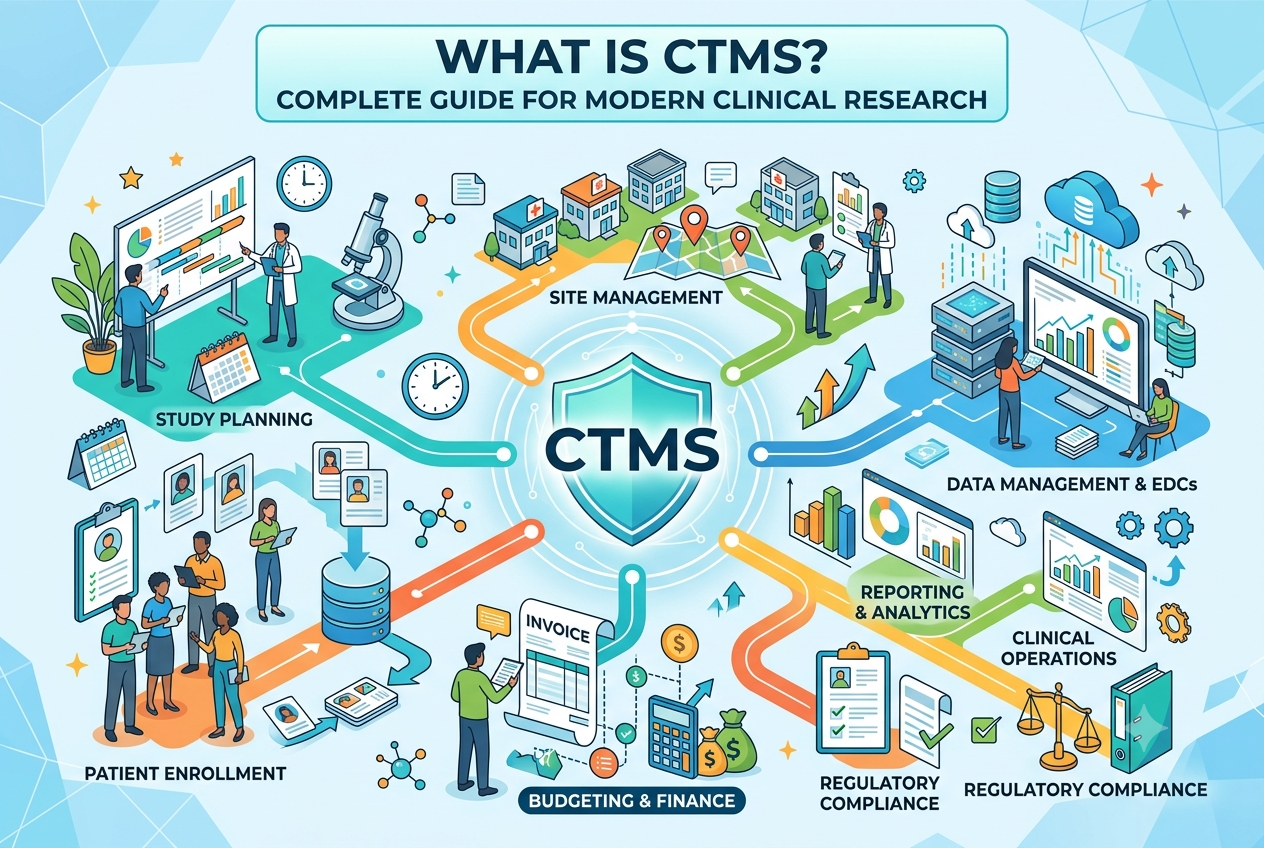
A Clinical Trial Management System is software designed to help sponsors, CROs, and research sites plan, manage, and track every operational aspect of a clinical trial. Rather than focusing on the clinical data collected from patients (that's the job of an EDC system), a CTMS focuses on the operational and administrative side of running a trial.

This includes things like:

* Tracking study milestones and timelines

* Managing site selection, activation, and performance

* Monitoring patient recruitment and enrollment

* Scheduling and documenting monitoring visits

* Managing budgets, payments, and contracts

* Tracking regulatory documents and approvals

* Generating real-time reports and dashboards for stakeholders

In simple terms, a CTMS is the command center for clinical trial operations. It gives clinical operations teams visibility into what's happening across every site and every study, in real time, so decisions can be made faster and with more confidence.

Modern clinical trial management software is typically delivered as a cloud-based CTMS, meaning it's accessible from anywhere, doesn't require heavy IT infrastructure, and can scale easily as an organization's trial portfolio grows.

Clinical trials involve an extraordinary number of moving parts. A single Phase III study might involve hundreds of sites, thousands of patients, multiple vendors, and years of activity. Without a centralized system, tracking all of this becomes a logistical nightmare.

Here's why a CTMS has become essential rather than optional:

1. Centralized Visibility A CTMS consolidates data from every site and every study team into a single source of truth. Instead of chasing updates through emails and spreadsheets, stakeholders can see real-time status at a glance

2. Faster Decision-Making When enrollment is lagging or a site is falling behind on documentation, a CTMS flags it immediately. Clinical trial operations teams can intervene early instead of discovering problems weeks later.

3. Regulatory Compliance Clinical trials are governed by strict regulations, including FDA 21 CFR Part 11 and ICH-GCP guidelines. A CTMS helps enforce audit trails, electronic signatures, and documentation standards that regulators expect.

4. Reduced Administrative Burden Manual tracking of site payments, contracts, and monitoring visit schedules consumes enormous staff time. Automating these processes frees up clinical teams to focus on higher-value work.

5. Better Resource Allocation With clear visibility into site performance and patient recruitment, sponsors can allocate monitors, budgets, and resources where they're actually needed instead of spreading them thin.


As trials grow more decentralized and data-intensive, the importance of a well-implemented CTMS platform will only continue to increase.

Before exploring how a CTMS helps, it's worth understanding the specific pain points that clinical operations teams face on a daily basis.

1. Fragmented Data and Siloed Systems Many organizations still rely on a patchwork of spreadsheets, email threads, and standalone tools to manage different aspects of a trial. This fragmentation makes it difficult to get a single, accurate view of study progress.

2. Slow and Inconsistent Patient Recruitment Recruitment delays are one of the leading causes of trial timeline overruns. Without a system to track enrollment funnels across sites, it's hard to identify which sites are underperforming and why.

3. Site Management Difficulties Coordinating site activation, training, document collection, and ongoing performance monitoring across multiple locations — sometimes across countries — is a significant operational challenge.

4. Manual Monitoring Visit Tracking Scheduling monitoring visits, tracking findings, and following up on action items manually increases the risk of missed deadlines and incomplete documentation.

5. Regulatory and Compliance RiskKeeping up with documentation requirements for ICH-GCP and FDA 21 CFR Part 11 compliance is difficult without a system that automatically maintains audit trails and version histories.

6. Budget and Contract ComplexitySite payments, invoice tracking, and contract milestones often involve complicated fee schedules. Managing this in spreadsheets is error-prone and time-consuming.

7. Limited Real-Time InsightLeadership teams often rely on outdated status reports because data has to be manually compiled from multiple sources before it can be reviewed.

These challenges compound as trials scale, which is why so many organizations are turning to dedicated clinical trial management platforms.

A well-designed CTMS directly addresses each of the pain points above:

A compliant eTMF software must include:

* Centralizing data eliminates silos by bringing site information, recruitment metrics, monitoring records, and financials into one platform.

* Recruitment dashboards give real-time visibility into enrollment funnels, helping teams identify underperforming sites early and take corrective action.

* Site management tools streamline site activation, document collection, training tracking, and performance scoring in one workflow.

* Automated monitoring visit scheduling ensures visits are planned, tracked, and documented consistently, with automatic reminders and follow-up tracking.

* Built-in compliance features, such as audit trails and electronic signatures, help maintain ICH-GCP and FDA 21 CFR Part 11 compliance without extra manual effort.

* Integrated budget and payment tracking reduces errors and gives finance teams clear visibility into contract milestones and site payments.

* Real-time reporting dashboards replace static, outdated reports with live data that stakeholders can access whenever they need it.

A CTMS rarely operates in isolation. To get the most value, it needs to work alongside other clinical trial technologies:

* CTMS + EDC (Electronic Data Capture) While a CTMS manages trial operations, an EDC system captures and manages patient clinical data. Integration between the two allows operational teams to correlate enrollment and data entry timelines, spotting data quality or site performance issues faster.

* CTMS + eTMF (Electronic Trial Master File) An eTMF stores the official regulatory and administrative documents required to prove GCP compliance. When integrated with a CTMS, document status and completeness can be tracked alongside operational milestones, reducing the risk of missing documentation during an audit or inspection.

* CTMS + Safety Databases Integration with pharmacovigilance systems allows operational teams to stay aware of safety signals that might affect site activity or patient recruitment strategies.

* CTMS + Financial Systemsand Connecting a CTMS to broader financial or ERP systems streamlines invoice processing and ensures site payment data flows accurately into company-wide financial reporting.

The goal of integration is to create a connected clinical trial operations ecosystem, where data moves seamlessly between systems instead of being re-entered manually — reducing errors and saving time.

System Primary Purpose Key Users
CTMS Manages trial operations — site management, recruitment tracking, monitoring visits, budgets, and reporting Clinical operations teams, project managers, CRAs
EDC Captures and manages patient clinical data collected during the trial Data managers, investigators, clinical research coordinators
eTMF Stores and organizes regulatory and administrative documents required for GCP compliance Regulatory affairs, quality assurance, auditors

Think of it this way: the CTMS answers "how is the trial running operationally?", the EDC answers "what clinical data have we collected?", and the eTMF answers "do we have the documentation to prove we followed the rules?"


Many organizations eventually connect all three systems, since operational, clinical, and regulatory data are deeply interrelated. However, understanding their distinct roles is essential when evaluating which clinical trial management platform best fits an organization's needs.

Selecting a CTMS is a significant decision that affects clinical operations for years. Here are the key factors to evaluate:

1. Scalability Can the platform handle your current trial volume as well as future growth across therapeutic areas, geographies, and trial phases?

2. Ease of Use A system that's difficult to navigate leads to poor adoption. Look for an intuitive interface that site staff and CRAs can learn quickly.

3. Compliance Readiness Confirm the system supports FDA 21 CFR Part 11 requirements and aligns with ICH-GCP guidelines, including audit trails and electronic signature capabilities.

4. Integration Capabilities Check whether the CTMS can integrate with your existing EDC, eTMF, and safety systems, or whether it offers open APIs for custom integrations.

5. Cloud-Based Deployment A cloud-based CTMS reduces IT overhead, supports remote and decentralized trial models, and typically offers faster updates and better accessibility.

6. Reporting and Analytics Evaluate whether the reporting dashboards provide the real-time insights your team actually needs, rather than generic, one-size-fits-all reports.

7. Vendor Support and TrainingStrong onboarding, training resources, and responsive customer support significantly affect how smoothly implementation goes.

8. Cost Structure Understand the full pricing model, including implementation, training, ongoing support, and any per-user or per-study fees.

9. Configurability Every organization runs trials differently. Look for a system that can be configured to match your existing workflows rather than forcing a rigid, one-size-fits-all process.

Taking time to evaluate these factors against your organization's specific needs will save significant frustration down the line.

A CTMS is only as effective as its implementation. Consider these best practices when rolling out a new system:

Start with Clear Requirements Document your operational workflows and pain points before selecting or configuring a system, so the CTMS is built around your actual needs.

Involve Site Staff EarlySince site coordinators and CRAs will use the system daily, involve them in the evaluation and configuration process to ensure the platform actually fits their workflow.

Plan for Data MigrationIf you're moving from spreadsheets or legacy systems, plan carefully for how existing data will be migrated and validated in the new platform.

Invest in TrainingComprehensive training for all user roles — sponsors, CRAs, site staff, and project managers — is critical for adoption and long-term success.

Roll Out in PhasesConsider a phased rollout, starting with a pilot study before expanding to the full trial portfolio, to identify and resolve issues early.

Establish Clear GovernanceDefine who owns data entry, quality checks, and system administration to avoid confusion once the system is live.

Monitor Adoption and Gather FeedbackTrack usage patterns and solicit feedback regularly during the first few months to fine-tune configurations and address user concerns.

Review Compliance Configuration RegularlyCompliance requirements evolve, so periodically review your CTMS configuration to ensure it continues to meet ICH-GCP and FDA 21 CFR Part 11 standards.

The CTMS landscape continues to evolve alongside broader trends in clinical research:

Risk-Based Monitoring (RBM) Adoption More organizations are shifting away from 100% on-site monitoring toward risk-based approaches, using CTMS analytics to identify which sites and data points need the closest attention.

Decentralized and Hybrid TrialsAs trials increasingly incorporate remote visits, telehealth, and home health providers, CTMS platforms are adapting to track operational data across more distributed care models.

AI-Assisted InsightsPredictive analytics and AI-assisted features are beginning to help teams forecast enrollment trends, flag at-risk sites earlier, and reduce manual data review.

Greater System InteroperabilityThere's a growing push toward open APIs and standardized data exchange, making it easier to connect CTMS, EDC, eTMF, and safety systems into a unified ecosystem.

Increased Focus on Patient-CentricityCTMS platforms are increasingly incorporating features that support patient engagement and retention tracking, recognizing that recruitment success depends heavily on the patient experience.

Cloud-First ArchitectureCloud-based CTMS deployment continues to become the default choice, offering easier scalability, faster updates, and better support for globally distributed teams.

Organizations that stay ahead of these trends will be better positioned to run efficient, compliant, and patient-friendly trials in the years ahead.

Yuva Infocare ARS CTMS is built specifically for the realities of modern clinical trial operations. It brings together study management, site oversight, patient recruitment tracking, monitoring visit management, budgeting, and compliance documentation into a single, cloud-based clinical trial management platform.


Here's what sets it apart:

* Purpose-Built for Clinical Trial Operations Every module is designed around real clinical operations workflows, not adapted from generic project management software.

* Compliance at the CoreBuilt-in support for FDA 21 CFR Part 11 and ICH-GCP requirements, with detailed audit trails baked into every action.

* Real-Time DashboardsSponsors, CROs, and site teams get live visibility into recruitment, site performance, and monitoring status without waiting for manual reports.

* Flexible IntegrationDesigned to connect with existing EDC, eTMF, and safety systems, reducing duplicate data entry and manual reconciliation.

* Scalable Cloud ArchitectureWhether managing a single study or an entire trial portfolio, the platform scales without heavy IT overhead.

* Dedicated Support and TrainingHands-on onboarding and ongoing support to ensure clinical teams get real value from day one.

For organizations looking to modernize their clinical trial operations without the complexity of legacy systems, Yuva Infocare ARS CTMS offers a practical, compliant, and scalable path forward.

1) What is the difference between a CTMS and an EDC system?
A CTMS manages trial operations — site management, recruitment, monitoring, budgets, and reporting — while an EDC system focuses specifically on capturing and managing patient clinical data collected during the study.

2) Is a cloud-based CTMS secure enough for clinical trials?
Yes. Reputable cloud-based CTMS platforms are built with role-based access controls, encryption, audit trails, and compliance features that meet FDA 21 CFR Part 11 and ICH-GCP requirements, often exceeding the security standards of legacy on-premise systems.

3) Can a CTMS help with patient recruitment?
Yes. Most modern CTMS platforms include recruitment and enrollment dashboards that track screening and enrollment funnels across sites, helping teams identify and address recruitment bottlenecks early.

4) Do small organizations or CROs need a CTMS, or is it only for large sponsors?
Organizations of all sizes benefit from a CTMS. Smaller CROs and sponsors often see an even bigger relative improvement in efficiency, since they typically have fewer staff available to manage manual tracking processes.

5) How does a CTMS support regulatory compliance?
A CTMS supports compliance through automated audit trails, electronic signatures, standarized documentation workflows, and structured tracking of regulatory milestones — all aligned with FDA 21 CFR Part 11 and ICH-GCP guidelines.

6) What is risk-based monitoring, and how does CTMS support it?
Risk-based monitoring is an approach that focuses monitoring resources on sites and data points with the highest risk, rather than applying uniform oversight everywhere. A CTMS supports this by providing analytics and dashboards that help identify which sites need closer attention.

7) How long does it typically take to implement a CTMS?
Implementation timelines vary based on organizational complexity, but a phased rollout — starting with a pilot study — often allows teams to go live within a few months while minimizing disruption.

Conclusion

Clinical trials are only getting more complex, and the organizations that succeed are the ones that bring structure, visibility, and automation to their operations. A Clinical Trial Management System is no longer a nice-to-have — it's a foundational tool for running compliant, efficient, and well-coordinated clinical research.


From site management and patient recruitment to monitoring visits, budgeting, and regulatory compliance, a modern CTMS platform touches nearly every part of clinical trial operations. When integrated thoughtfully with systems like EDC and eTMF, it becomes the connective tissue that keeps sponsors, CROs, and sites working from the same accurate, real-time picture.